The Bible That Borrows Part 3: The Qumran Bible

Jesus and the Jews of his day didn’t read the scriptures the way you and I do, and today I’m going to prove it.

….

Last week was illuminating for some and distressing for others. We talked about what I think are the brilliant ways that the Old Testament’s writers borrowed from Babylon to talk about a God whose chief interest was not the mighty Babylonian Empire, but the people on its underside. We talked about the first books of the Bible, which were not written by Moses, but by a post-exile nationalist. Finally, we talked about Adam, who is less an historical character and more a mythological character who was crafted to symbolize the struggle and hope of the nation of Israel.

Those who struggled the most with last week’s installment for the most part observed a contradiction between two facts: (1) my whole argument depended on Moses not writing the first books of the Bible and (2) Jesus on many occasions says or implies that the Torah came from Moses.

Jesus really does do that. And repeatedly.

(Despite the concern’s undeniable validity, I’m always amused when it comes in the form of “You obviously haven’t read what Jesus said.”)

Really, I take this concern seriously.

So seriously, that this and the next week’s installments are all about that concern.

Today, we will talk about the Essenes of Qumran and how scholars believe they influenced the New Testament’s writers. Next week, we will talk about Jesus, who came to Earth, pitched his tent among us, and became a Pharisee (yes, he did that).

What I’m going to talk about today and next week has caused me to love Jesus even more than I already did.

So, let’s go for it.

The Jewish Sects of the New Testament

First, the Essenes are best understood in the context of greater Judaism, so I first need to talk about the Jews themselves. We Christians talk about them a lot, certainly, but in my experience our discussions mostly operate to support our conceptions of ourselves. When we talk about Judaism, we are usually projecting onto it the things we don’t want in Christianity.

In these next two weeks, I will try to avoid doing that.

The writers of 1 Kings and 1 Chronicles tell us that the high priest when King Solomon finished the temple in Jerusalem was a man named Zadok. Nine centuries later, the “sons of Zadok“—you know them as the Sadducees—were one of the Jewish sects of the first century. True to their name, these sons of Zadok were all about their Temple. The Temple was their identity.

The Sadducees were the priestly order, the elite, and—unlike the Pharisees, about whom I’ll talk shortly—they believed that the only acceptable way to worship God was in the Temple (which is why the Sadducees died out when the temple was destroyed in 70 CE). They affirmed the Torah, but not the other parts of the Hebrew Bible—what Jews call “the Prophets” and “the Writings” (the Nevi’im and Ketuvim).

They also had no regard for Greek ideas like eternal life and resurrection (I’ll highlight that in two weeks).

If you were to sit down at the bar with a Sadducee, he would tell you that the purpose of life was literally what the Torah says it was: God’s provision in this life at the cost of making the right sacrifices in the right ways in the Temple in Jerusalem.

On the other hand, the Pharisees sought to distance Judaism from the trappings and elitism of the Temple. They were the democratizers of Judaism. They brought Judaism down from the unapproachable mountain to the people.

Their distinguishing characteristic were the rabbis. The rabbis traveled throughout Judea making among the ordinary people disciples of the Torah and the other scriptures. To them, personal prayer and study of the Hebrew Bible (the “Tanahk”) were each an acceptable means of worshiping God, even on par with the Temple worship of the Sadducees.

The Pharisees interpreted the Torah more liberally than the Sadducees, especially with the way they permitted the observance in the home of certain Jewish holidays that were originally commanded to be in the temple.

This comes as a surprise to most modern Christians.

We often use the phrase “legalistic Pharisee” to describe someone who is hyper technical about commands in the text. While I hate that phrase, at least “legalistic Sadducee” would be more accurate.

The Caves of Qumran

Now that I’ve introduced the Pharisees and Sadducees, let’s talk about the Essenes.

Israel and Rome went to war in 66 CE, and it didn’t go well for Israel. Within four years, Rome completely destroyed Jerusalem and within another three years completely destroyed Masada, the mountain city in southern Israel.

During the war, the Roman army led by Titus (who would succeed Vespasian to the throne as emperor of Rome) surrounded and accepted the surrender of an army led by Flavius Josephus, an Israeli general and governor over Galilee.

After his surrender, Josephus accepted an offer of commission from the Roman Senate to become a Roman citizen and write a history of the Jewish people for the Roman government.

Which deserves an applause. By any measure, that is a spectacular rebound!

It’s hard to overstate how much Jewish history we know because of two of his works—The Jewish War and the Antiquities of the Jews. In The Jewish War, Josephus provides a detailed account of each of the Jewish sects. He describes the Sadducees, the Pharisees, and also the Essenes, a small group sworn to poverty that lived in the wilderness of Qumran near the Dead Sea. For nearly two thousand years, we knew little of the Essenes other than what was written in The Jewish War.

And then came a goat.

In 1948 in the Dead Sea region near Khirbet Qumran, a goat under the watch of an Arab Bedouin shepherd ran away from the herd, up a hill, and into a cave. The shepherd, hoping to scare the goat back down the hill, threw a rock into the cave, but the sound from the impact didn’t make the usual sound of a rock against limestone.

Qumran-Caves1.jpg

There were 2,000-year-old scrolls in there.

Instead, it made a ping sound.

That shepherd could have had no idea that the impact came from what was the first of what would be hundreds of scrolls that archeologists and scholars of ancient Hebrew call the Dead Sea Scrolls. Even when the shepherd found the scrolls, he could have had no idea what he had; the Bedouin were neither literate nor Hebrew speakers.
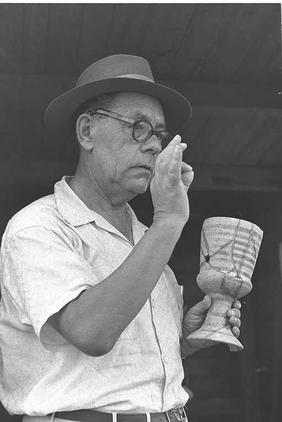
E_L_Sukenik_1951.jpg

Professor Sukenik

After a series of discreet payoffs and handoffs reminiscent of a le Carré spy novel, the scrolls eventually ended up in the hands of Professor Eleazar Sukenik of Hebrew University, who immediately set out to publish the contents of the scrolls for the general population. Once the scrolls were published, scholars quickly and widely recognized them from Josephus as belonging to the Essenes of Qumran.

Scholars widely believe that when Titus’s army marched into Judea during that war I mentioned, the Essene community stored their most important scrolls in the caves located above Khirbet Qumran and fled south to a Masada in hopes of one day returning to Qumran and their scrolls.

But, they never returned.

As an aside, on the very night that Professor Sukenik brought home the first discovered Qumran texts, the United Nations voted to approve a plan to establish an independent Jewish state in Palestine. Professor Sukenik noted in his diary that on the day the UN established an Israeli state, he held documents untouched literally since the last time there was an Israeli state.

Over a series of decades, more documents in other caves above Khirbet Qumran were discovered. While the first cave had seven documents (a great find by itself), the fourth cave contained more than five hundred documents!

Five hundred!!!!!!!!!!

!!!!!!!!!!!!!!!!!!!!!!!!!!!!!!!!!!!!!

In sum, archeologists have recovered over nine hundred documents from the caves of Qumran—unquestionably one of the great finds in archeological history.

So, what did the Dead Sea Scrolls tell us about the Essenes, and what does that have to do with the Bible?

The Qumran Yahad

We’re going to talk about some of those documents, but first let me introduce you to the Essenes, who were as much a community as a Jewish sect.

We learn as much about how the community thought of itself from the Serekh ha-Yahad (סרך היחד) (“The Community Rule”) as any other Dead Sea scroll. The Community Rule strikingly identifies differences between itself and the mainstream Jews of the time.

The document begins with the community—the Yahad—and the covenant each member would make to disavow worldly possessions in favor of a communal lifestyle.

The community was led by a so-called—and unidentified—”Teacher of Righteousness” and referred to itself as the “Sons of Light“. Imbued in the text of the Community Rule is the posture of a minority group that saw itself as oppressed by the mainstream Jewish sects, whom the Community Rule and many other Dead Sea scrolls refer to repeatedly as the “Sons of Darkness“, and which were led by the so-called—and also unidentified—”Liar.”

Keep these names and phrases in mind because they show up throughout virtually all Qumran literature, which we’ll be talking about today.

The Essenes thought of Yaweh in much the same way as other Jews. Where they differed with the Pharisees and Sadducees was in the strictness with which they interpreted the Torah. The Serekh ha-Yahad begins by instructing the Yahadnot to deviate in the smallest detail from any of the words of God.” Of course, all Jews would basically ascent to that statement, but, as you will see, the Essene community really took it to a special level.

Here’s an example.

It’s well known that ceremonial cleanliness is a major theme in Jewish law, and the book of Leviticus lists any number of ceremonially unclean things for Jews to avoid. Further—and similar to the properties of coodies as understood by every single 1st grade child—the state of “uncleanliness” can be transported upon contact from person to person or even thing to thing.

  • So, if an unclean animal such as a pig touched an otherwise clean object like a water jug, on contact the water jug would become unclean.
  • And any person who touched the water jug would become unclean.
  • And if water from the unclean jug was poured into a clean jug, the clean jug would become unclean.

All Jews would be in agreement so far.

But what would happen if a clean water jug poured water into an unclean water jug? Would the uncleanliness travel up the downward-pouring water to the clean water jug?

This is something Jews actually debated. Really.

The Pharisees said “nah”.

The Essenes said “oh, most certainly yes”.

You may think this disagreement . . . well . . . small, but it was because of this that the Community Rule instructed the Sons of Light to “hate the Sons of Darkness with the vengeance of God.” The foundation of the Yahad that we find in the Community Rule and other Qumran texts—most notably the apocalyptic “War Scroll“—is life as a cosmic battle between the Sons of Light (themselves) and the Sons of Darkness (all other Jews).

Harsh.

Hypertechnical.

(Though not terribly removed from many of the stupid controversies I’ve personally witnessed from time to time in my own churches of Christ.)

One more example.

The Community Rule specifically commands the Yahad “not to advance their holy times and not to postpone any of their festivals.”

What does this mean?

Generally when reading an ancient document that makes such a stern prohibition like this, you can assume that other sects were doing the thing.

And they were.

But, why?

The book of Exodus commands Jews not to do any work—including cooking—on Saturday, the Sabbath day. But Saturday is not the only Sabbath Day. The book of Leviticus also commands Jews to observe a Sabbath during some Jewish holidays. So, imagine if a Jewish holiday fell on the day immediately before or after Saturday. All work and cooking would be forbidden for two consecutive days.

First of all, fasting two days in a row is painful enough, but in this time of no refrigerators, this would also be a logistical problem.

On years when this would have been an issue, the Pharisees and the Sadducees solved the problem simply by adjusting the calendar. Nothing in the Torah explicitly forbids this, but nothing authorizes it. And so the Essenes argued against it from silence in the text.

And lived all alone.

Why do I provide these examples? Is it just to show how smart and important I am?

No.

I provide these examples because if you want to appreciate the main points of my discussion today, you need to appreciate how strictly the Essenes interpreted their text.

So, let’s get back to one of the original questions. How might the Essenes have been so influential to the writers of the New Testament?

Baptism

Matthew c3 introduces New Testament readers to John the Baptist, a man of the wilderness whom the gospels describe in the likeness of another inhabitant of the wilderness, the prophet Elijah. Matthew tells us that people went out to him from all over Israel to confess their sins and be baptized in the Jordan River.

If you’ve read the Old Testament enough times, in the back of your mind you’ve probably wondered whether you might have been missing something.

Where did John get the idea to immerse people in water for the forgiveness of sins?

There’s nothing in the Old Testament that commands or even hints at this. Of course, Jews have a long legacy of ritual cleansing before meals and other events as a means of obtaining “ceremonial cleanliness”, but in Judaism uncleanliness and sinfulness are not the same thing. To the Jews, forgiveness of sin is done through the high priest on the annual Day of Atonement, not through ritual cleansing in water.

It turns out, for all the strictness with which these Essenes interpreted the Hebrew text, they were the pioneers of the Christian tradition of baptism for the forgiveness of sins. Neither Paul, nor Peter, nor John the Baptist, nor Jesus Christ invented baptism for the forgiveness of sins. That small, poverty-sworn group in Qumran did.

So, was John the Baptist an Essene?

Or was he at least raised as an Essene?

Again, the text never mentions the Essenes explicitly, but the case is strong.

In addition to the Essene’s practice of baptism and the fact that the Essenes apparently lived in the wilderness near the Jordan River—what the Essenes tell us about themselves is even more striking.

  • They committed themselves to poverty and an ascetic lifestyle,
  • their main enemies were what they perceived as the overly permissive Pharisees,
  • they only wore clothes and ate food from within their community, and
  • they wrote in a distinctly apocalyptic tone.

If you were to make a list of each core Essene characteristic, you could easily find them in John the Baptist.

Oh.

And the Essenes even called the Pharisees a “brood of vipers.”

Have you heard that phrase before?

Are you beginning to see it?

Good.

Because I’ve barely started.

Sons of Light

As I said earlier, the first command of the Community Rule, the Serekh ha-Yahad, commands the sons of light to hate the sons of darkness with the vengeance of God. As I mentioned earlier, the battle between light and darkness saturates Qumran literature.

So, you might wonder: do any of the New Testament authors talk this way?

Oh.

Yes.

The apostle John recorded that Jesus told his disciples to “Believe in the light while you have the light, so that you may become sons of light.”

Cool.

Is that it?

No way!

The battle between light and darkness is the driving theme behind the entire gospel of John. Like the Big Bang of the universe, John’s gospel begins with an explosion of light. Here’s the beginning of chapter 1.

In the beginning was the Word, and the Word was with God, and the Word was God. He was with God in the beginning. Through him all things were made; without him nothing was made that has been made. In him was life, and that life was the light of all mankind. The light shines in the darkness, and the darkness has not overcome it.

There was a man sent from God whose name was John. He came as a witness to testify concerning that light, so that through him all might believe. He himself was not the light; he came only as a witness to the light.

The true light that gives light to everyone was coming into the world.

Light light light light light . . . all mixed in with John the Baptist, who we just observed was the early pioneer out in the wilderness of the Essene baptism. It is this man whom John the apostle calls a witness to, what else, but the . . . light.

Yes!

And once John finishes with chapter one, he doesn’t put on the brakes. Really, he takes the light-dark-light-dark theme into overdrive.

  • This is the verdict: Light has come into the world, but people loved darkness instead of light because their deeds were evil. John c3 v19
  • Everyone who does evil hates the light, and will not come into the light for fear that their deeds will be exposed. John c3 v20
  • But whoever lives by the truth comes into the light, so that it may be seen plainly that what they have done has been done in the sight of God. John c3 v21
  • John was a lamp that burned and gave light, and you chose for a time to enjoy his light. John c5 v35
  • When Jesus spoke again to the people, he said, “I am the light of the world. Whoever follows me will never walk in darkness, but will have the light of life.” John c8 v12
  • While I am in the world, I am the light of the world. John c9 v5
  • Jesus answered, “Are there not twelve hours of daylight? Anyone who walks in the daytime will not stumble, for they see by this world’s light. John c11 v9
  • It is when a person walks at night that they stumble, for they have no light. John c11 v10
  • Then Jesus told them, “You are going to have the light just a little while longer. Walk while you have the light, before darkness overtakes you. Whoever walks in the dark does not know where they are going. John c12 v35
  • I have come into the world as a light, so that no one who believes in me should stay in darkness. John c12 v46

Did John endorse every view of the Essene community? I doubt it. I don’t think John endorsed every view of the Essenes any more than the Old Testament writers endorsed every view of the Babylonians.

Like Ralph did in the Old Testament, John borrowed.

The Pesher Habakkuk

If I ended this part of my essay on the Bible right here, sure, it would be cool. But I promise I’ve saved the most important part for last. In this last section, I discuss the Pesher Habakkuk, arguably the single most important Dead Sea Scroll for unlocking the mystery of the New Testament authors’ treatment of the Old Testament text. Pesher is the Hebrew word for “commentary” or “interpreting.”

If you want to understand why I’m not concerned with Jesus’s mentions of Moses, do not skip this part.

The original Old Testament book of Habakkuk is written from the perspective of the prophet Habakkuk, whom God warns of the coming Babylonian destruction of Jerusalem.

Habakkuk c1 v5–7

Look at the nations and watch—and be utterly amazed. For I am going to do something in your days that you would not believe, even if you were told. I am raising up the Babylonians, that ruthless and impetuous people, who sweep across the whole earth to seize dwellings not their own. They are a feared and dreaded people; they are a law to themselves and promote their own honor.”

Read the above text. There should be no doubt—none whatsoever—that Habakkuk’s writing concerned Babylon (or, in some translations, the Chaldeans—same thing). I made it bold for you just to make it easy. Again, Babylon. No one other than Babylon. And in fact, Babylon was the new world power during the time when Habakkuk was written and in fact did destroy Jerusalem.

So, there is no reason to believe Habakkuk was talking about anyone other than Babylon.

Are you with me?

So let’s go to the 1st century BCE Pesher Habakkuk. Early in the text, the writer quotes Habakkuk c1 v5–7, but something remarkable happens. 

The pesher writer disagrees with you.

“Interpreted, this concerns the Romans, who are quick and valiant in war, causing many to perish.” Pesher Habakkuk, column 1 lines 10–12 (emphasis added)

Okay.

Perhaps you’re just skimming this whole essay.

But I have to ask.

Did you notice that?

I hope you did because of the ridiculous amount of time I spent emphasizing it for you. The author of the pesher completely ignored the original meaning of the text and reinterpreted it in light of his present circumstances. Almost like saying, “I know you thought—and maybe even Habakkuk thought—he was writing about Babylon, but I really don’t care.”

Remember, this was written by an Essene. These are the guys who read the text more strictly than everyone else.

Habakkuk c2 v2

In Habakkuk c2 v2, God gives Habakkuk a vision and commands him: “Write down the vision, and make it plain on the tablets.” Throughout the book of Habakkuk, God explains to Habakkuk how the Babylonians will exercise dominion on the Earth, but will eventually lose it.

For the pesher writer, however, the text spoke to something entirely different. The Essenes were distinctly apocalyptic among Jews. That is shorthand for saying that they believed in an end of time, a concept you won’t find in the Torah.

But what you and I wouldn’t see, the pesher writer fills in for us.

The pesher writer says: “And God told Habakkuk to write down that which would happen to a final generation, but he did not tell him when it would come to an end.”

Habakkuk literally says nothing like this.

Habakkuk is concerned with the fall and rise of Jerusalem. But from the perspective of the pesher writer, this world seemed hopelessly miserable and unredeemable. What Habakkuk wrote about had happened centuries earlier, and the yahad needed something that could speak to their present despair. The yahad was determined to find their apocalyptic views in any text—even in texts that had nothing to do with the end of times.

Let’s never forget in this academic discussion that we are dealing with real human people.

Moving on, why should Habakkuk write down the vision “plainly” on tablets? Verse two continues, “so that he who reads it may read it speedily.” Again, the most natural way of reading this is God telling Habakkuk to write down the vision so at a later date other readers can access it easily.

Not so, says the pesher, for it tells us, “This concerns the Teacher of Righteousness, to whom God will make known all the mysteries of the words of his servants the Prophets.”

For someone like me who was raised to value the “historical-grammatical” method of interpretation, the Pesher Habakkuk is almost comical at this point. If any one of us reasoned in the pulpit on Sunday in this manner, we would be summoned before the church elders.

Habakkuk c2 v4

Habakkuk c2 v4 is one of the most famous passages in all of scripture: “The righteous shall live by his faith.” Jews to this day understand this to mean that the righteous person will prosper through (1) his or her faith in Yaweh and (2) the Torah he gave to Moses.

But again, the pesher writer contends that everyone here is mistaken. He writes, “This concerns all those . . . whom God will deliver . . . because of their faith in the Teacher of Righteousness.”

In other words, Habakkuk c2 v4 is not about faith in God, but faith in the leader of the Qumran sect.

(Hint: Habakkuk wasn’t writing about the Essenes.)

Maybe this all doesn’t impress you very much, but to me, it’s stunning.

And understand, there are many pesher texts: Pesher IsaiahPesher HoseaPesher NahumPesher ZephaniahPesher Psalms are notable examples.

I grew up thinking that the most faithful way to interpret a text was to ascribe to it its original meaning. Or at least try to do that.

Reinterpreting texts was somehow dishonest. It was what those activist judges supposedly do.

Is the 9th Circuit Court of Appeals in good company with 1st century ancient Hebrews?

You may consider yourself what is often called a “strict constructionist”—one who tries to interpret a text based on the literal meaning of what words most naturally meant in their time. And you may be surprised that a group of Jews who interpreted their text so strictly also interpreted it so liberally.

But, as I’m about to show you, the people who wrote the Bible you have read and carried to church each Sunday were even more liberal with the text than the Essenes.

They were even more liberal than the Pharisees.

Pesher in the New Testament

“Live By His Faith”

Earlier, we saw how the Pesher Habakkuk interprets Habakkuk c2 v4 to mean faith in the Teacher of Righteousness.

The New Testament also quotes Habakkuk c2 v4, three times in fact (Romans c1 v17, Galatians c3 v11, and Hebrews c10 v37–38).

However, each time, the writer uses the passage to mean something other than what it originally did. In each case, the writer uses it to say that the righteous will live by (1) faith in a man who lived on the Earth and (2) departing from the Torah.

Again, the mainstream Jews understood Habakkuk c2 v4 to mean—and it probably did originally mean—faith in Yaweh and his Torah.

Nobody—not the Essenes, not anybody—thought Habakkuk c2 v4 was an invitation to leave the Torah. But the New Testament writers were perfectly willing to re-read old texts in light of present circumstances.

And it didn’t stop with Habakkuk.

Out of Egypt

When Israel was a child, I loved him, and out of Egypt I called my son. But the more they were called, the more they went away from me. Hosea c11 v1

In the big picture, the Old Testament tells the story of God rescuing the Hebrews from slavery in Egypt, and settling them in the land of Israel. However, the story continues that despite God’s provision, the Israelites repeatedly rejected God’s commandments as given through Moses. When we read the above passage from Hosea, this is what we are reading. Hosea isn’t predicting a single thing. He is describing something that had already happened.

Also, I think every human being alive would agree that the “son” Hosea is talking about is Israel.

But, Matthew, like the Pesher writer, thinks you’re wrong. In Matthew c2, we are told that because King Herod tried to kill every firstborn child in Israel, Jesus’s parents hid away in Egypt until they returned and settled in Nazareth. Matthew, once again—by our standards—playing fast and loose with the text, gives us this commentary:

So he got up, took the child and his mother during the night and left for Egypt, where he stayed until the death of Herod. And so was fulfilled what the Lord had said through the prophet: “Out of Egypt I called my son.” Matthew c2 v14–15

Can you imagine how Matthew’s first readers would have reacted to that? Think about what a daring thing it would have been to write that. If you wanted to be a pesher writer, you needed some big cajones!

When you go back to Hosea, Matthew’s assertion is stunning. It probably was uncomfortable in his time, but is even more uncomfortable to the modern reader.

The Virgin Birth

In Matthew c1 v23, the angel Gabriel tells Mary, a virgin, that she will conceive and that her son would save people from their sins. After this, Matthew comments that this was to fulfill what was prophesied in Isaiah c7 v14.

But did Isaiah do that?

In Isaiah c7, King Ahaz of Judah learns that Israel and Syria are planning to invade Judah. Isaiah then prophesies to King Ahaz that God will not thwart the military invasion. To prove this prophecy, Isaiah tells Ahaz to ask God for a sign, but Ahaz responds that he would not put God to a test.

Isaiah responds, “The Lord himself will give you a sign: The virgin will conceive and give birth to a son, and will call him Immanuel.”

Jews from Isaiah’s day to the present had much to say about Isaiah c7 v14, but not that this boy would be the Messiah. The text, which has much to say about Judah’s deliverance from Israel and Syria, has nothing to say about a Messiah. Further, in the original Hebrew of Isaiah c7 v14, the word “almah” meant only a young woman who had not yet given birth. For a woman to be an almah, it did not matter than she was a virgin. That said, the Greek translation that Matthew had rendered almah as “parthenos”, a Greek word that specifically means “virgin”. This gave Matthew the opportunity to interpret Jesus as the fulfilment of Isaiah.

An opportunity upon which he seized.

Humorously, while neither Mark, Luke, or John mention anything about a virgin birth, when the Revised Standard Version translators in 1952 rendered almah as “young woman”, conservative Christians accused the translators of tampering with the Christian Bible.

The God of Abraham, Isaac, and Jacob

I mentioned earlier that the Sadducees didn’t believe in the immortality of the soul or any kind of resurrection. So, in Matthew c22, the Sadducees approach Jesus—who emphatically taught that people would be resurrected.

That same day the Sadducees, who say there is no resurrection, came to him with a question. “Rabbi,” they said, “Moses told us that if a man dies without having children, his brother must marry the widow and raise up offspring for him. Now there were seven brothers among us. The first one married and died, and since he had no children, he left his wife to his brother. The same thing happened to the second and third brother, right on down to the seventh. Finally, the woman died. Now then, at the resurrection, whose wife will she be of the seven, since all of them were married to her?”

This question is obviously meant to trap Jesus into admitting that, in this time when women were mere property of their husband’s, the resurrection was going to invite some nasty property disputes in this so-called Heaven he had been preaching about. Jesus had none of it. According to the McNeal Revised Version*, Jesus responded, “There is no property in Heaven.”

*(Not an actual translation.)

But Jesus wasn’t done. Thinly veiled behind the Sadducees’s question was the insinuation that the resurrection of the dead was a bunch of hogwash.

What Jesus did next was straight out of the pesher tradition I’ve belabored today.

Jesus replied, “You are in error because you do not know the Scriptures nor the power of God. When the dead rise, they will neither marry nor be given in marriage; they will be like the angels in heaven. Now about the dead rising—have you not read in the Book of Moses, in the account of the burning bush, how God said to him, ‘I am the God of Abraham, the God of Isaac, and the God of Jacob’ ? He is not the God of the dead, but of the living.

On its face, Jesus’s words seem innocuous enough until you read how wildly Jesus used Exodus c3.

In Exodus c3, God appears to Moses in a burning bush and identifies himself to Moses as the same God whom Abraham, Isaac, and Jacob worshipped. Literallyno one ever had read Exodus c3 and concluded that it had anything to do with Abraham, Isaac, and Jacob still being alive.

Did Jesus, the Son of God, take scripture out of its original context?

Oh yes.

Which, by the way, is funny to me because this text is so frequently used by people who want to prove that Moses wrote the first books of the Bible.

Are you beginning to see why I see it differently?

(Not asking you to agree with me. Just to see that I’m not totally insane.)

This passage is also used as a proof text for Jesus being better at the scriptures than everyone else.

I agree that he was.

But how was he better?

Were his historical-grammatical hermeneutical chops the best?

Were the Jews just lazy and not very interested in their scriptures?

Or was Jesus the best at the scriptures because he dared to stretch their meaning even further than anyone else ever dreamed?

And what’s even more amazing to me is that the Pharisees witnessed the whole discussion . . . and loved it! Jesus’s pesher take wasn’t controversial!

“Well said, teacher!” they said.

Can you even handle this?

Concluding Thoughts

I sometimes get criticized for over elaborating on certain topics, and I have a long history of this. When you observe me do this about a particular topic, what you’re seeing is an insecurity of mine. I expect my audience will not be receptive to what I’m saying.

Here’s what you need to understand.

I really could have kept going. I cut out an astounding amount of material.

If you want more examples of the theme I’ve described, here are a few others:

  • John’s use of Isaiah c40 v3;
  • Jesus’s use of Psalm 82 in John c10;
  • Paul’s use of Genesis c12 v7, c13 v15, and c24 v7 in Galatians c3 v15-29;
  • Paul’s use of Isaiah c49 in 2 Corinthians c6 v1-2;
  • and more.

To the first century Jew, faithfulness to the text meant testing its boundaries and creatively applying it in order to “discover” the true heart of God. This is so different than our stereotype of them and our common usage of the text.

We have to remember this when we read the New Testament. The New Testament writers—like the Old Testament writers—had agendas. And they read the Old Testament with agendas. They were not these automatons who lacked control over what they wrote.

The New Testament writers were convicted that a carpenter’s son from Galilee named Jesus was God in the flesh, and they re-read their text to conform to those new convictions.

Next Week

On the foundation I have laid today, next week we’ll talk about Jesus as a first century Pharisee.

Part 1, Part 2, Part 4

The Bible That Borrows Part 2: The Babylonian Bible

I was six years old and living in the drab, grayish-brown desert outside of El Paso, Texas.

One Sunday, a family from church kindly invited us to their house for lunch. Like any good Texas family, they lived about as far away from every other human as they possibly could.

Also, like any good Texas family, they owned an enormous amount of what ordinary people would assume completely useless land. And, like, six or seven four-wheelers.

My story begins after lunch on this day, when their ten-year-old son took me out on one of them. I rode on the back, and we took that little two-stroke wonder everywhere. Full speed down the slopes, nimbly around rocks and thistles and the occasional groupings of cacti.

For a six-year-old boy, this was peak life. My soul was wide open (as were my eyes and mouth).

And that’s when the boy driving that four-wheeler turned around, looked me right in the eye, and yelled, “DUCK!!!”

He yelled it loudly. He yelled it clearly. And before you and the Almighty, his voice traveled back to me just fine. So, you probably expect that we were approaching some low obstruction and that, whatever it was, I ducked below it.

You are correct that we were approaching a low obstruction.

However, in my six years on the Earth of running around, kicking soccer balls, hopping fences, getting dirty, and watching Looney Tunes—for whatever reason—nobody had ever used the word “duck” to me like that before. I’ve never been extremely tall, and even the tallest six-year-olds can safely walk beneath most things. Also, I had lived the first four years of my life in the Philippines, and many people there don’t speak English all the time. To this point, I’d only lived in the US for two years.

So, when he looked back at me and said “duck”, the image that appeared in my head was . . . a duck.

And I began looking around for one.

As we approached his house, what came next—perfectly at the level of my head and at about twenty miles per hour—was a clothes line.

Everything above my neck immediately halted, but my legs and feet continued forward with the momentum of the four-wheeler below me.

Which meant the next thing was the rebound.

My forty-five pound body was no match for that clothes line, and I propelled off of it so hard that for a moment time seemed to stop. As I seemingly floated there, hands clawing at the air, it was as if for two seconds or two years—hard to say from my perspective—Newton’s laws of motion gave way to Einstein’s general theory of relativity. And then . . .

*THUD*!

“I yelled back at him to duck!” the boy truthfully explained to his dad, who looked guilt-ridden at my dad, who turned back at me and asked, “Did you hear him call at you to duck?”

Now, today I can admit how ignorant I was then, but six-year-old me was no idiot. As I scanned the room, it was clear that I was the only person who hadn’t already known that word, and context clues had more than filled in what to me had previously been unknown. And nobody likes to be that ignorant guy, that guy who took out a baseball that was signed by Babe Ruth and actually played with it.

So I preserved my dignity.

“No, I couldn’t hear him over the sound of the four-wheeler,” said me, who heard him just fine.

I didn’t know it at the time, but God taught me something about the Bible that day. And I learned it more than twenty years later.

….

This week’s installment is information heavy, and much of it won’t seem interesting right away. I know how busy you are, and I want to honor your time, so let me tell you exactly where I’m going.

Traditionalists generally believe that Moses wrote the Bible’s first five books, and around 1,400 or 1,500 BCE.

However, virtually everything I believe today about the Bible hinges on one foundational premise: Not only did Moses not write the first books of the Bible, but they were written about a thousand years after his time—after Babylon destroyed Jerusalem. Once you accept this premise, the Bible—let alone its first five books—takes on a different character.

That’s where I’m taking you. Now, let me make my case.

Genesis c1

Most people don’t wake up in the morning and think about the Bible’s writing style. The good news is I do, so you don’t have to.

The Hebrew Bible begins with the immortal words, B’eresheit bara Elohim, commonly translated “In the beginning God created.” Whoever the author was, he made important choices when he began the Bible this way, and in a short time we will come right back to them in detail. Those choices matter.

For right now, I simply want you to notice how these words relate to what the writer says next. In verse two, we are told that the Earth (“ha’arets”) was tohu wa’vohu, commonly translated “wild and waste”. So, with the phrases b’eresheit bara and tohu wa’vohu, we are two verses into Genesis c1, and we can see that the writer of Genesis c1 has either a habit or a preference for alliteration. You’ll see why this is important when we get to Genesis c2.

Then the writer gives us a series of number patterns; we are told that God spent the first three days separating:

  • on day one, dark from light;
  • on day two, the “waters above from the waters below”; and
  • one day three, the sea from the land, etc.

Once separated, God spent the next three days sequentially filling the things he separated, and in the same order of the things that he separated. So, we are told:

  • on day four he filled with the sun, moon, and stars what he separated on day one—the heavens;
  • on day five he filled with birds and sea creatures the things he separated on day two—the sky and the sea;
  • on day six he filled with land animals the thing he separated on day three—the land from the sea.

Hebrew writing after the Babylonian exile frequently employs the same parallel literary structures found in Genesis c1. Zechariah is one example, but there are plenty more.

It is also interesting that this Elohim fills the things he separates, because the Hebrew word bara, which usually gets translated “created”, more literally means “filled” or “fattened.”

(The same word we translate “created”, we translate “fattened” in Genesis c41 about the cows in Pharaoh’s dream).

The rhythm continues with the writer at the end of each day informing us that God saw what he made was “good”. The Hebrew word for “good” is tov. Because the word tov appears twice in the text with reference to the third day, Jews for thousands of years have believed that the third day of the week is double blessed and usually have weddings on that day. Don’t believe me, read the first sentence of John c2.

More numbers. To some, what follows will sound forced and even spurious at first. Especially, because Rob Bell says it, considering Rob Bell apparently is the devil. But there are distinct patterns of threes, sevens, and tens in Genesis c1.

Threes

We’ve already seen one pattern of threes—there are three days of separating and three days of filling. Also, bara occurs in three different places in Genesis c1. In the last place, it occurs three times.

Sevens

The first sentence in Hebrew is seven words. The second sentence is fourteen words. Ha’arets is written twenty-one times. Elohim is written thirty-five times. “It was so” is written seven times. “And God saw” is written seven times.

Patterns of three. Patterns of seven.

*Yawns*

Three and seven add up to ten (I can’t believe I just wrote that).

*Yawns harder*

Yes? Okay, bear with me.

Tens

“To make” is written ten times. “According to their kinds” is written ten times. “And God said” is written ten times—three times about people, seven times about other creatures. “Let there be” is written ten times—three times about the heavens, seven times about ha’arets.

See it now? Patterns of threes and sevens and tens—they are the skeletal structure of Genesis c1The writer of Genesis c1 prefers orderly literary arrangement, which is interesting because the narrative, which describes a transition from chaos to order and arrangement, begins with “deep water”—which, in ancient near-eastern literature is typically a literary device used to symbolize chaos. Here, the writer depicts Elohim conquering chaos and making order. He does so not just through the narrative of the creation, but also through a literary structure that begins with the ineloquent “tohu wa’vohu” (kind of like saying “wishy washy” or “splishy splashy”) to the majestic orderly arrangement of the days of creation.

You’ll understand in about ten minutes why this transition from chaos to order is important.

One more point from verse one. The translation, “In the beginning”, isn’t bad, but probably could be improved. Amy-Jill Levine argues persuasively that it should be “When in the beginning.” Another permissible translation is “When in the summit.”

Again, you’ll understand why this too is important in about nine minutes and fifty seconds.

Finally, throughout the Old Testament, there are numerous names that we translate “God.” Here, the Hebrew writer of Genesis c1 chose the name Elohim each time. This is interesting to say the least because the word is both plural and generic—really on par with saying “the gods.” For some reason, the writer of Genesis c1 did not like to use the sacred name, Yahweh. Although, perhaps even more strangely, this will change very suddenly.

And that’s the end of Genesis c1. Now that Elohim has created all ha’shamayim (Heavens) and ha’arets (Earth), the modern reader gets to the subsequent chapters ready to see what happens in those primordial places. In a sense, that’s the rest of what the Bible covers.

Sort of.

Genesis c2 and c3

Okay, so you’ve just read the account of the creation. If the Bible was like any other work of literature written by a single person, we would expect to move on to what happens next, right?

But that’s not what happens in Genesis c2.

When you get to Genesis c2, the story just seems to start over:

“This is the account of the heavens and the earth when they were created, when the LORD God made the earth and the heavens.” Genesis c2

You may think that’s an odd thing to say. That c1 was about creation, so we should be moving on now. Right?

So you read on, perhaps thinking those words aren’t meant to tell you what’s coming, but simply to summarize what the reader just read.

But something weird happens.

Genesis c2 has *ANOTHER* account of the order of creation

And it’s different.

And if Genesis c1 is correct, then Genesis c2 is wrong.

In the Genesis c1 narrative there were plants before humans, but in the Genesis c2 narrative there were humans before there were plants. Further, in Genesis c2 animals are made after humans, even though Elohim made them before humans in Genesis c1 (English translators try to “fix” this, but the Hebrew is unmistakeable—especially if you read verses 18 and 19 together).

And speaking of Elohim, the writer of Genesis c2 and c3 suddenly and without explanation starts referring to God as Yahweh—no longer just Elohim.

And that’s not all that has suddenly changed. Remember the number patterns I talked about? Number patterns of any variety go away. Even in English, Genesis c1 has an unmistakeable beat and rhythm, but Genesis c2 and c3 trade beat and rhythm for an arhythmic narrative prose.

Finally, instead of alliteration as the linguistic art form, the author of the chapter goes all out in aggressively making puns. First, God makes “man” (the Hebrew word for man is “adam”) out of the ground (the Hebrew word for ground is “adamah”). In other words, according to this ancient Hebrew suburban dad, God makes the “adam” out of the “adamah.” And then the first man is named Adam.

The serpent we are told is arum (“cunning”), but the humans are arumim (“naked”). The names of the rivers make their own pun in the story, though this one requires more explaining, and I think you get the point.

A few questions need to be asked.

Why are there two creation stories?

Why are they stylistically different?

Why are they factually different?

Why do all these changes happen at the same time?

Are there other parts of the Bible that act this way?

If the answer is yes (the answer is very yes), does that mean something?

Stick with me.

II Samuel tells a story about God causing King David to conduct a census of Israel. Then I Chronicles (written many centuries after II Samuel) tells us the EXACT story about King David’s census. Only in the chronicler’s retelling, SATAN rather than God caused King David to do it. That’s a detail—was it God or Satan?—that, had these stories been written simply by God zapping them down to human writers, you would have expected him to have told the same way both times (really, you would expect him to just tell the story once). In fact, II Chronicles—written two or three centuries before Christ—records the very first reference to any person specifically named “Satan” in the whole Bible.*

*(“The serpent” in Genesis is never called Satan. “Satan” in Job is actually “ha’shatan” which literally means “the accuser.” The account in Chronicles, likely a 3rd-century writing, is the first time anyone in the Bible wrote about someone namedShatan” or שָּׂטָן.)

The Bible is full of these doublets.

In fact, there are about thirty more in just the Old Testament.

Which raises many questions, chief among them:

Uh, why?

Again, going back to the idea that these are the direct words of God, does God have a habit of forgetting that he has already told a particular story? Not that I could blame him. I have told many stories to the same people many more times than just twice.

But does God forget how he originally told the story?

Or is something else really important happening here?

(There is.)

I just described several divergent characteristics of Genesis c1 and Genesis c2. It’s worth noting that these discernible patterns come and go in unison throughout the Bible, even within the same books.

It’s almost as if the finished versions of these books are a patchwork of concurrent narratives that later—probably centuries later, and perhaps during a time of national trauma—were sewn together.

(Actually, that’s exactly what they are.)

Documentary Hypothesis

The writer of Genesis c11 tells us that Abram’s father, Terah, was 70 when Abram was born, and that Terah died at the age of 205. A little subtraction tells us that when Terah died, Abram would have been 135. Right?

(Take a second and do this math.)

The writer of Genesis c12 (and reiterated in Acts c7) tells us that after the death of Terah, God told Abram to leave Harran. So, again, Abram must have been no less than 135 when he was called to leave Harran. Right? Right?

(Take a second and make sure you’re still with me.)

But Genesis c12 v4 specifically says that Abram was 75 when he left Harran.

Meaning, one of these two accounts in your Holy Bible is wrong.

And that’s my point. There are at least two accounts.

At least two.

Again, the traditional view has long been that Moses wrote the first five books of the Bible (called the “Pentateuch”), but scholars of the 18th century and on to today have seriously questioned that view in light of the composite nature of the text—doublets that in unison take on different literary forms, use different names for God, and often contain contradictory information. Further, increasingly more scholars in the last two centuries have taken seriously a variety of sentences that Moses almost surely didn’t write:

  • Numbers c12: “Now Moses was a very humble man, more humble than anyone else on the face of the earth.” (Because what humble man writes that?)
  • Deuteronomy c34: “No one knows [Moses’s] burial place to this day.”
  • Deuteronomy c34: “Since [Moses died], no prophet has risen in Israel like Moses.” (This statement most naturally suggests that consider time had passed, and many prophets had come and gone since Moses).

So, let’s talk about documentary hypothesis. You may need a cup of coffee for this part, but if you want to understand modern biblical scholarship, I promise this is something you need to know.

The literal story of the history of the Jewish people describes God establishing the priestly order before the nation of Israel became a thing. However, about a century and a half ago, a Lutheran from Germany, Julius Wellhausen, pondered several profoundly dangerous questions.

If the Bible is potentially made of composite sources that contradict each other, is it possible that the Bible is not an accurate record of Israel’s history? And, if so, is it possible that the priestly order did not begin until much later? And, if so, what does that mean?

His seminal work, Prolegomena zur Geschichte Israels (“Prolegomena to the History of Israel“), is often compared to Charles Darwin’s Origin of the Species. It is long, tedious, and not exactly full of humor.

But it is probably the most important modern work of Christian theology.

The idea Wellhausen systemically described—and which is where nearly all modern scholars begin, even if they diverge somewhat from his view—generally holds that there were at least four independent sources—one from Judah (what scholarly works call the “J” source), a source from its northern neighbor, Israel (the “E” source), the author of Deuteronomy (the “D” source), and the Priestly source (“P”).

According to Wellhausen, what we today call the Old Testament (what Jews call the Tanakh) is a dicing and splicing of these sources by a later editor (who Wellhausen calls a “Redactor”).

His theory is called documentary hypothesis, and here’s a picture of it.

400px-Documentary_Hypothesis_Sources_Distribution_English.png

But again, to one who considers the Bible without factual error, it matters little where these sources came from or who put them together. If God one day caused some guy named Ralph to write down and splice together what had once been parallel oral traditions, that would not be theologically significant. As long as these people were writing word-for-word the words of God and not their own opinions, inerrancy would be safe.

Today, when some part of the Bible appears to be in conflict with another, evangelicals usually say that we simply need to think harder or that the proper understanding hasn’t yet been revealed to us.

The idea that the Old Testament books were themselves composite works assembled by an editor had been suggested before Wellhausen’s time. What Wellhausen did was systematically identify the composite parts. And once he deconstructed them, he persuasively put them back together in a way that has since led to the creation of hundreds if not thousands of conservative safe places. Wellhausen advanced two main arguments:

First, the Old Testament does not accurately reflect Israel’s history.

Second, when Ralph or whoever else assembled and edited the Old Testament, he did so to advance an agenda specific to the Israelites who were recovering from a national trauma.

In painstaking detail, Wellhausen demonstrated that, contrary to how it appears in the text, the priestly order and the law were not present throughout all of Israel’s history. That thousands of years of simple worship became increasingly formalized over time.

And it turns out that archeology is WAY more favorable to the 19th century Wellhausen than to modern conservative evangelicals.

  • The entire Old Testament is written using a Hebrew alphabet system that did not exist during Moses’s time;
  • There are town names in the books of the Old Testament that did not exist during Moses’s time;
  • Centuries-old archeological digs of Jericho do not support the story of its destruction described in the book of Joshua; and
  • There is little to bear out the story of a large, enslaved Hebrew ethnic group in Egypt, as described in the book of Exodus.

Moses did not write the first five books of the Bible. Nor is much of the Old Testament historically reliable. Nor was it ever intended to be. Nor is the Old Testament nearly as “old” as its name suggests.

To many people, this is terrifying. The common reaction to Wellhausen is that the Bible cannot be biased because that would make it just any other work of human literature. Notice the straw man argument used to describe documentary hypothesis on the evangelical website, Got Questions?.

Screen Shot 2016-10-08 at 3.49.44 PM.png

Got Questions? scoffs at documentary hypothesis as just “liberal theology’s attempt to call the veracity of the Pentateuch into question.” And that’s unfortunate. Documentary hypothesis is not an attempt to do anything other than reach a reasonable conclusion from the totality of the evidence. Documentary hypothesis should be judged on its own merits rather than the motivations of some of its advocates.

Some of your brains are presently on fire, and that’s perfectly fine. Changing your mind is no small feat, and not without consequences. Walk with me.

I’m going to take you to the 6th century BCE literature of the Babylonian Empire. When the Israelites were held as captives in Babylon during this time, it is virtually certain that they were exposed to their literature. The authors of the “books of Moses” borrowed from Babylonian literature to make specific theological arguments to their people.

Arguments I literally affirm.

Babylon

I told you earlier that I would talk about the importance of the choices that the author made in writing the first sentence of the Bible. Let’s do that now.

The Babylonian army of King Nebuchadnezzar conquered the known world in the 6th century BCE, Israel and Judah in 586 BCE. The Bible gets this right. One of the most important characteristics of the conquering was “the exile”—Jews forcibly removed from their land in and around Jerusalem and placed in Babylon.  When there, the exiles were exposed to Babylonian literature, and I want to highlight two pieces of literature on which scholars have written extensively. Keep your Genesis hat on.

The first is the Enuma Elish.

The Enuma Elish begins with the Apsu, the god of fresh water, and Tiamat, the goddess of deep salt water. These two gods are depicted to represent primordial chaos. Then, a god named Marduk leads gods of wind against Apsu and Tiamat.

In this battle between the older gods of water and the younger gods of wind, the wind gods essentially blow up the salt water god, Tiamat, and split her open in two. The top half made a vault of water in the sky; the bottom half made the earth’s sea.

Does this ring a bell?

Also, remember how Genesis c1 begins with the “spirit”, or literally “wind”, of Elohim hovering “over the deep”? Interestingly, the Hebrew word for deep, tehom, when enunciated sounds almost exactly like Tiamat. In fact, the etymology is the exact same.

Does this ring a bell?

(If it doesn’t ring a bell, read it again. Keep reading it until it does.)

At the end of the story, Marduk creates humanity out of the blood of Tiamat and humanity being made slaves to Marduk and his buddies, a convenient end for Babylonian kings who were made to be viewed as gods.

Notice the similarities:

  • Both stories establish order out of chaos.
  • Both separate “the waters above from the waters below.”
  • Both start with darkness before the creation.
  • Both involve wind blowing on deep water.
  • Light exists in both before the creation of the sun, moon, and stars.
  • The sequence of creation is similar, including the creation of the “firmament”, dry land, stars, sun, and humanity.
  • The creation is followed by rest.

One last thing, and the point to which I’ve been building for the last fifteen minutes. Remember how I mentioned earlier that “When in the summit” is a possible translation of the first words of Genesis?

The first words of the Enuma Elish are “When on high.”

The clever writer of Genesis c1 wants his powerless and oppressed Israelite comrades to know one specific thing.

The gods of powerful Babylon are up on high.

But Elohim, the God of lowly Israel, is higher.

!!!!!

I love it.

Next, The Epic of Gilgamesh.

The Epic is long, but the relevant part of it begins with a god who tells a certain Utnapishtim (1) that the other gods are going to wipe out the world with a flood and (2) to build a boat. Utnapishtim builds a boat and brings animals on the boat. He even sends out a bird to see if the water has receded.

Even traditionalists can admit that this at least resembles the story of Noah, but there’s more.

Utnapishtim is granted the gift of immortality. Later in the story, Gilgamesh wants to revive his friend, Ankidu. After some cajoling, Utnapishtim tells Gilgamesh that there is a plant on the bottom of the sea that will grant Ankidu immortality. Gilgamesh dives to the bottom of the sea and actually gets the plant. When Gilgamesh reaches the surface, he is tired from the dive and takes a nap.

Guess what comes and takes the plant away during his sleep.

Seriously, guess.

Yeah.

A serpent.

Ever hear about a serpent that separated humans from an immortality-granting plant?

Haha, I sure do.

In light of the internal elements of the Old Testament that point to it being written after the exile, as well as the literary works the Israelites would have been exposed to during the exile, I’ve become convinced that the Old Testament wasn’t written to tell history. At least not the way we tell history.

It’s much more interesting than that.

So Why Was Genesis Written?

I have taken great pains to show you how Genesis borrowed so heavily from Babylonian literature, and you have taken even greater pains to read it. What I’m going to do next is tell you what I think it means.

The Old Testament was put together after the Babylonian exile, a time when the people of Israel were recovering from a national crisis. The Israelites—whose core understanding of God was tied to their land—were asking themselves “If God allowed us to be exiled from our land, is God still with us today?” Ralph the assembler of the Old Testament was a priest who wanted the people of Israel to know that God was still with them. However, God would keep them in their land only if they maintained zeal in worshiping him according to the priestly code we read in Leviticus and not just in any old way.

(Today, we sometimes use what is said about the Old Law to strain the New Testament for every discernible instruction on worship we can find, lest we be consumed for offering a “strange fire.”)

Adam is a mythological character who symbolizes the Israelites. The Garden of Eden is the temple in Jerusalem where Heaven and Earth come together. Adam is exiled from the land that God gave him, just as the Babylonians exiled the Israelites from their land. And Adam is exiled from the garden because of his desire for earthly power, just as the priests argued that Israel was so exiled from their land.

Importantly, while our Ralph borrowed from Babylonian literature to make his argument, he also carefully distinguished Elohim from the gods of the stories from which he borrowed.

  • The sun, moon, and stars are depersonalized;
  • Light exists before the sun appears (an insult to their often-hostile neighbors to the south, the Egyptians, who worshipped Ra);
  • Chaos is depersonalized;
  • Creation was effortless;
  • There’s no divine conflict;
  • If Marduk was “on high”, Elohim apparently is in the “summit”, the highest place; and
  • Elohim doesn’t make humans his slaves.

In other words, the God of Genesis is bigger, better, higher, and more compassionate than the god of Israel’s neighbors. If there’s a literal truth in Genesis, that’s it!

In subsequent posts, I’m going to show other ways the Bible does this. Really, if you want to be a person who goes “back to the Bible”, you need to go back to the Bible’s writers and their conventions for telling their national stories. They aren’t ours.

I sometimes get called a “liberal” for how I read the Bible. But ask yourself: what’s more liberal? To interpret the Bible using our modern standards of telling history or to interpret the Bible using their standards?

This brings me back to my original story.

We often hear the ancient Hebrews the same way I heard my friend on that four wheeler years ago in El Paso. Sometimes they tell us to duck, and we go about the barren, lifeless West Texas desert in search of a duck.

Next Week

This week’s installment argued that Moses didn’t write the first five books of the Bible. This bothers some of you because you’ve read the New Testament and know that Jesus called those books the “book of Moses.” You’ll understand better what Jesus is doing very soon and why it doesn’t bother me.

Next week we’ll build on this discussion and talk about the Dead Sea Scrolls. See you then!

Part 1 Part 3

The Bible That Borrows Part 1

In the summer of 2012, I had to face the Bible class I had taught for two years and announce that I wasn’t sure if I believed in God anymore. In fact, I was basically sure I didn’t. I’ve always tried to be transparent with people, and I wasn’t going to pretend to believe in something I knew I really didn’t.

What it came down to was the Bible.

No book in history has been as consequential or influential, but I could no longer get behind it. Either my view of God was correct or my view of the Bible was correct.

But not both.

It took me three years from that summer to arrive at what I now believe. And once I figured out what I believed (and I did), it took me another year just to figure out how to talk about it. Today, I believe in God more strongly than I ever have in my life, and, in the interest of remaining transparent, I want to spend the next several weeks talking about where I’m at.

Because I really, really like it.

Automatons

I was brought up to think of the Bible’s writers as automatons. Transcribers. Mere copyists.

I agreed that humans wrote the Bible, but only in the sense that a printer might be said to write something. Yes, their pens moved in the correct ways—but the thoughts, the motivations, and the genius behind the words weren’t theirs; they were always God’s. Really, had the Bible’s writers no awareness of what they were writing—had they written the whole thing in their sleep—it would have made little difference to me.

Squeezing out of the Bible every trace of humanity was how I understood reverence for the power and glory of God Almighty, so I grew up uneasy with those smug ivy-league academics who from time to time would write about the Bible authors’ purposes and motivations. Kind of like when someone orders a “pop”, my fine-tuned southern mind instantly identifies them as not from around here (and probably not trustworthy).

I was brought up to understand the Bible through the prism of such unimpeachable labels as “inspired,” “infallible,” and “inerrant,” and the only reason anyone might venture into the dangerous territory of its writers’ so-called biases, politics, and agendas was because they were set out to disprove God.

Or, if such a person claimed to be a believer, it was only because they were one of those new-age liberals who were always just trying to explain away the clear words of scripture. Such people were a lesser form of believer—a kind in name only. They wanted easy, comfortable religion. Not like the real Christians—me included—who were honest and brave enough to read scripture for what it says.

But it went deeper. It’s not like I was happy for those people to just have their space while I had mine. No. They were threatening. Not really to me, but to the souls of millions and billions of other people whom they would deceive and send hurtling down to Hell. Because if we can’t believe every part of the Bible as literal and historic truth, then everyone would be free to do and believe whatever they wanted. And that was unacceptable.

As Albert Mohler, president of the Southern Baptist Theological Seminary, writes:

I believe that the affirmation of the Bible’s inerrancy has never been more essential to evangelicalism as a movement and as a living theological and spiritual tradition. Furthermore, I believe that the inerrancy of Scripture is crucial to the project of perpetuating a distinctively evangelical witness into the future. Without inerrancy, the evangelical movement will inevitably become dissolute and indistinct in its faith and doctrines and increasingly confused about the very nature and authority of its message.

Or as J. I. Packer asserts:

The Bible is word for word God-given; its message is an organic unity, the infallible Word of an infallible God, a web of revealed truths centered upon Christ; it must be interpreted in its natural sense, on the assumption of its inner harmony; and its meaning can be grasped only by those who humbly seek and gladly receive the help of the Holy Spirit.”

If you’ve ever been to any of the numerous country churches I’ve been to, you’ve almost surely heard it reduced to the simple maxim:

“The Bible says it. I believe it. That settles it.”

Right or wrong, inerrancy is a fragile doctrine. It’s an exhausting doctrine. It’s a doctrine constantly on the defense, constantly scanning the horizon for new attackers. And in the last two centuries, it’s only been attacked on increasingly more fronts.

Some Problems With the Bible

Genesis c1 and the subsequent text—if taken literally—demands that the universe was created six thousand years ago in six days, and the Apostle Paul affirms in his gospel to the church of Rome that Adam was the first human. If you—like me—are inclined towards the findings of people who for decades have committed themselves to the rigorous and difficult study of the sciences, this is a major problem.

A problem that in increasing numbers leads people to bitterly leave church and faith.

  • The number of fossils we can estimate is in the quintillions, which means that if the universe is only six thousand years old, the Earth would have been insanely crowded throughout that time.
  • Most of the stars we see in the sky are more than six thousand light years away, which means if the universe is only six thousand years old, their light wouldn’t have had enough time to reach us, and the night sky would be quite darker.
  • Proteins are constantly splitting up the double helix of DNA and making copies of what scientists often call the four “letters” of the DNA “alphabet.” Sometimes one of these proteins makes a molecular “typo,” and a new strand of DNA begins replicating. Most of the time, these changes aren’t terribly consequential, but sometimes they are. And sometimes a change works to the advantage of the plant or animal. Sometimes, the advantage becomes so profound that over a long time a new species is created. Sounds cool, huh?

Well, what I just described is evolution, and we can witness the entire process under a microscope.

Cara_de_quem_caiu_do_caminhão....jpg
Look at this dog. Seriously, just look at him. Now, any reputable dog scientist looking at this picture would instantly conclude that he likes to sit on peoples’ laps, lick their faces, and chase tennis balls. That he is a delight to all humankind. A joy in a world of pain. A light in a world of darkness.

But the same scientists would also tell you that this dog’s ancestors were ferocious wolves.

Again, look at him.

While this dog and his ancestors benefitted from artificial selection—less aggressive traits and loss of freedom in exchange for a steady food supply from their new human masters—I too benefitted from the same basic evolutionary process, though via natural selection. I didn’t evolve from monkeys—as is commonly said—though with them even the most careful scientists are confident that I share a common ancestor.

The fossil record is more clear on this score than my early theologically trained but not biologically trained religious mentors had me to believe. Inerrancy alienated me and continues to alienate many from people who for decades of their lives personally have carried on the quiet and meticulous investigation of difficult scientific questions. In a desperate effort to cling to what we’ve always known, we fall victim to the pseudo-scientific word salads that evangelical leaders employ to keep us within their orbit.

This often takes the form of folksy soundbites that, to people with no background in these subject matters, make scientists seem out of touch and too big for their britches.

7497328a82a1c87b703598282548d15189267d821550d757f0cf0d62a8cd11e5.jpg

And that’s just with the sciences.

Inerrancy requires us to worship a God who seems to have been okay for a long time with things that most modern people categorically deem immoral.

With attacking people and making them your slaves.

With wiping out the ethnic groups in the land of Canaan.

Men ruling their wives.

With selling your daughter into slavery.

With beating your slave.

Stoning a rebellious child.

Genocide.

Until Jesus came, and God . . . changed his mind?

These attacks come from many places and many things, so—unsurprisingly—evangelicals avoid many things. Evangelicals protect their children from having to hear smart and persuasive people expound on any of this. When we get backed into a corner, we tell ourselves that the problem isn’t the Bible—it is something WE are missing, for “God moves in mysterious ways,” (a verse not actually found in the Bible).

And then we spend thousands of dollars to protect our children from public schools and cartoonishly militaristic atheist professors.*

*(To be absolutely clear, I have no problem with private, religious schools. I have a big problem with sheltering children from intellectual struggle.)

Our unwillingness to honestly address these issues hurts ourselves, but not just ourselves. I really believe in my faith for the whole world, but our insistence on an inerrant road-map-compass-instruction-manual Bible is an unscalable wall for most people who don’t already share our fear of theological disruption.

It was an unscalable wall for me in 2012, and I grew up with this stuff.

Interestingly, however, there is one thing on which most traditional evangelical Christians and most ardent atheists completely agree. In fact, you could say it is the topic of this whole series. Bill Maher puts it well:

“[T]he Bible says this is 100% true. The Bible says you have to take it like that. If it’s not 100% true, I would say the whole thing falls apart.” – Bill Maher

There’s this mindset among evangelicals that there are those who are faithful and believe every word of the Bible to be true in the modern sense, and there are those who are just “doing some funny dance.”

I’m going to spend the next two months seriously challenging this idea.

Whatever your view of the Bible, inerrancy places a weight on it that I’ve become convinced it never asked to carry. Dr. Peter Enns puts it best:

Supposedly, it is unworthy of God to speak through ancient stories of origins that are neither historical nor scientific. God is the God of Truth. He would never stoop so low. Uh…actually…yes he would. God is all about stooping low—way low. That’s how God rolls—at least the Christian God.

I’m excited about what’s in store. So excited that I had to divide this topic into eight (eight!) installments to capture it. There’s just so much to talk about. And I’m a madman.

I hope you’ll come back here at 7:00 pm on Mondays for each new installment. We will really get into the meat of the topic next week. I doubt you will completely agree with me at the end, but I also doubt you will completely agree with yourself at the end.

Part 2